
For years I hopped from distro to distro, and the thing I kept looking for was a computer I could understand. Two projects came out of that search: Abyss Linux, a Linux desktop without systemd, and Lumen VM, a virtual machine app for Apple Silicon Macs. I think small, readable software is the only kind you can really own, and both are my attempt to prove it.
What I wanted from a distro
My list was short. Small programs I can read in an afternoon. A rolling release. No systemd. A minimal base. And not a fork of a fork.
Void Linux met every one of them. That is why I stopped hopping and started building on it.
Why small matters to me
This is opinion, not a benchmark. When a program is small enough to read in an afternoon, I can find out what it does instead of trusting what it claims. When it is not, I am relying on other people for everything, and I will never know how much.
That is the idea behind the suckless philosophy, which stresses simplicity, clarity and frugality. It is also why I like init systems where a service is just a directory with a run script. Void uses runit for this, and Abyss keeps it.
Abyss is Void with a desktop on top
Abyss is not a new distribution built from nothing, and I do not pretend it is. Underneath it is Void: Void's repositories, its kernel and its tools, with its own package manager, XBPS, and its own build system, xbps-src. The Void documentation is still the right place to learn how the base works.
What I added is the desktop. It is dwm, st, dmenu, slock and tabbed, the suckless tools, patched and themed in purple, with a status bar for network, CPU, RAM, disk and the clock, and one menu for everything else. The configuration lives in C and is compiled in. The idle desktop sits at around 300 MB of RAM.
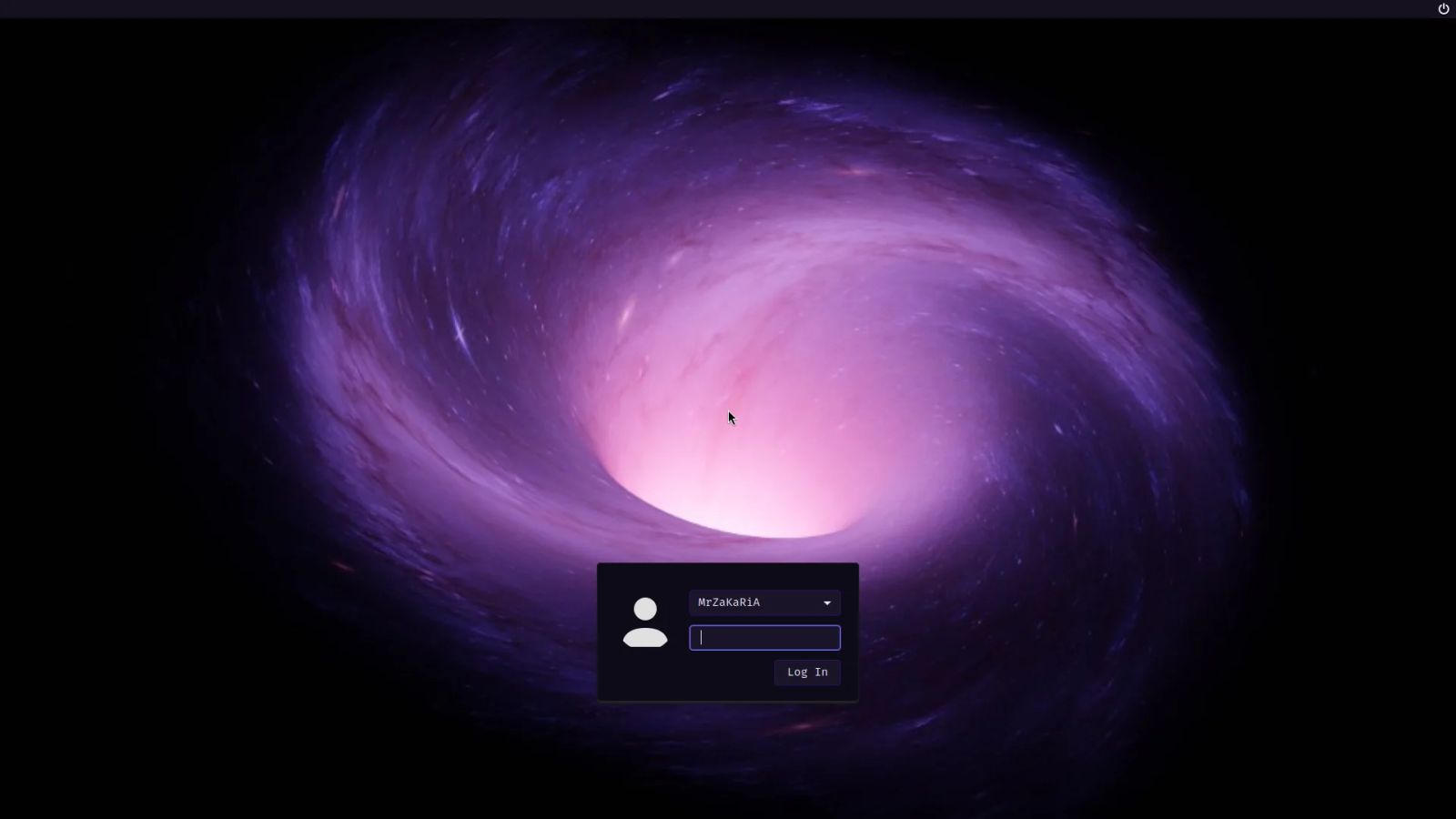
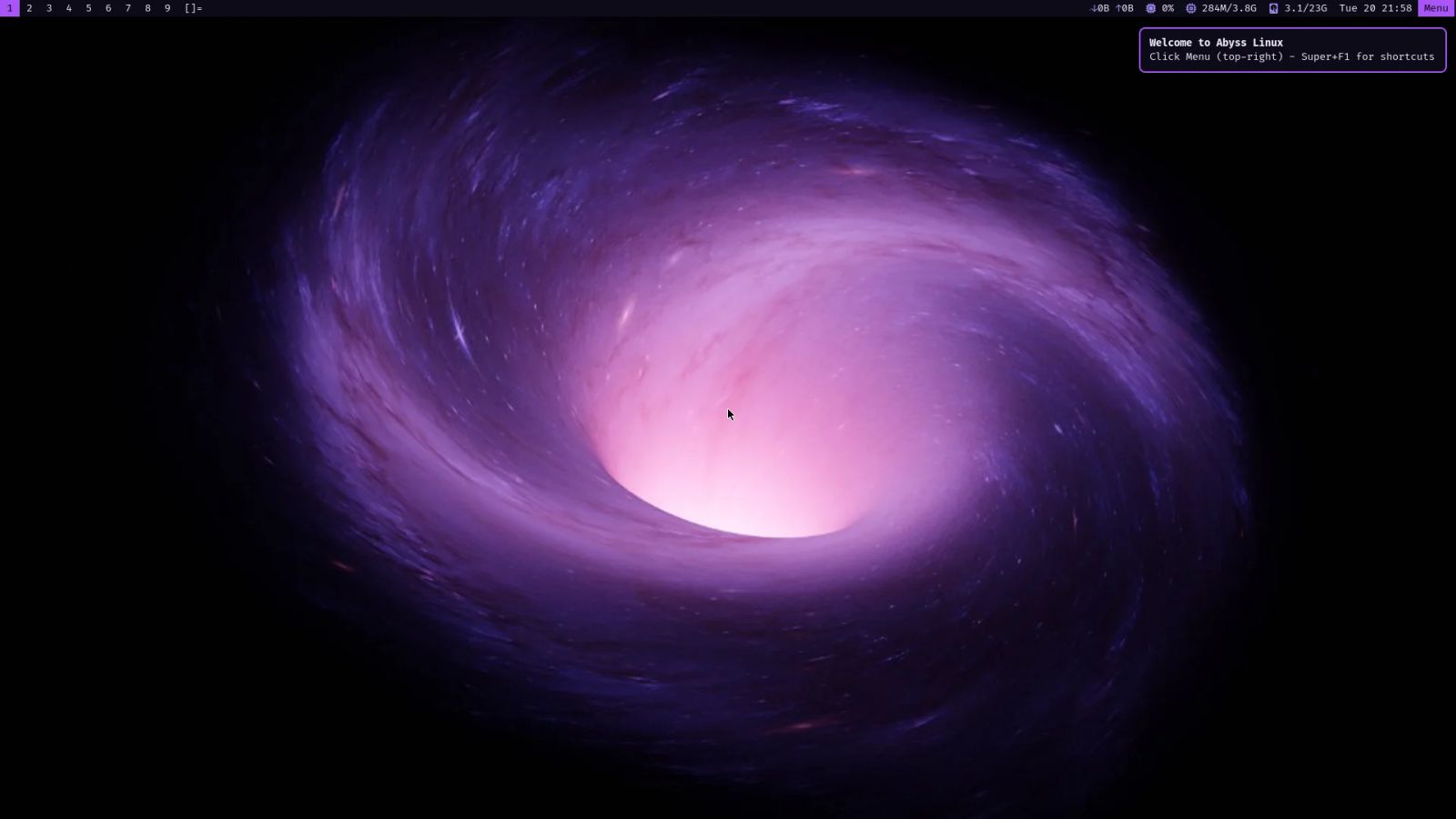
The repository was created on 19 October 2026, and release 27.0 followed on 20 October. Release 27.1 came on 21 October with a boot splash, a login screen on the same artwork, a shutdown fix, a new menu and a new status bar. Most of the code is shell and C, which suits a project like this.
The part nobody sees
The patched suckless builds do not ship only inside the ISO. They come from a separate project, the Abyss package repository, a signed XBPS repository built by GitHub Actions. I started it on 19 October, the same day as the main repository.
I did that so that updates reach people without a new ISO. If you are on 27.0, one command, sudo xbps-install -Su, brings the updated packages; only the boot splash, the login screen and the new menu need a fresh install. A desktop that can only be improved by reinstalling it is not rolling in any sense that matters to me.
Why I needed a VM app
I wanted to run Abyss on my own Apple Silicon Mac, and the natural way is as a guest. I wanted that to feel like part of the Mac rather than a window full of settings I never asked for. That is the reason for Lumen.
Lumen is a native SwiftUI app that runs macOS and ARM64 Linux through Apple's Virtualization framework, with Windows 11 ARM64 as an experimental guest on QEMU. It is written in Swift. The first release, v27.0.0, appeared on 11 October 2026. The 27.1.0 release arrived on 21 October with opt-in Rosetta for Linux guests, opt-in nested virtualization on an M3 or later with macOS 15, one-click download of the latest macOS restore image, and security hardening.
Capacity is a limit, not a reservation
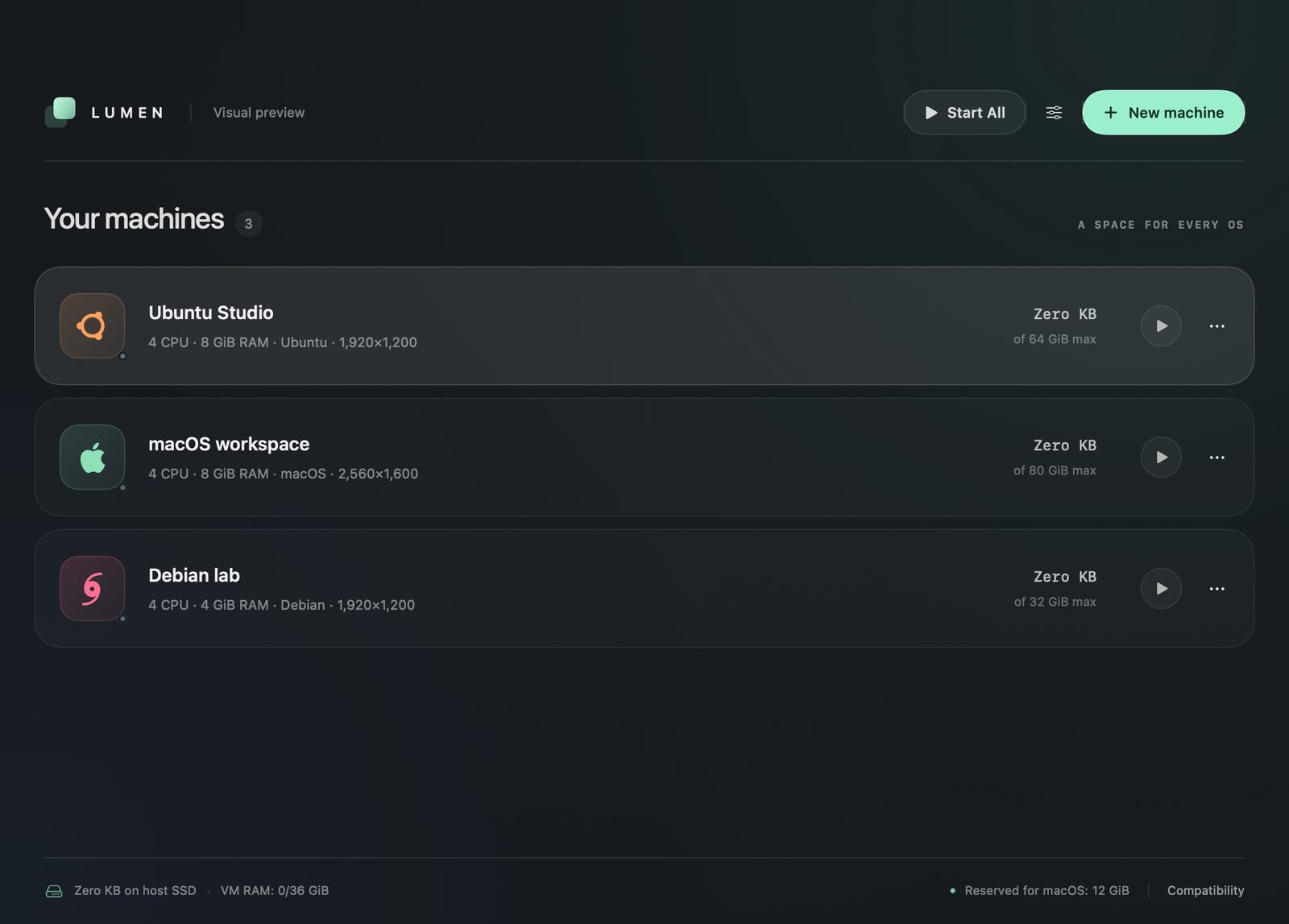
This is the Lumen decision I care about most. A virtual disk should not take its full size from your SSD on the first day. A new 64 GB disk in Lumen is sparse: blocks are allocated only when the guest writes them, and a brand-new machine shows zero kilobytes used.
On a Mac, where you cannot simply add internal storage later, I think anything else is disrespectful. Lumen shows the real use in the library, lets you grow a stopped disk later, and the Linux guest tools enable fstrim.timer so the guest can hand space back.
The release notes are candid about Windows. They say plainly that it is experimental, that there is no 3D acceleration yet, and that the v27.1.0 changes have not been exercised against live Windows or Linux guests. I think publishing the limits is part of being honest about a project.
Using them together
Lumen lists Abyss and Void as tested guests. Its Linux guest tools set up the clipboard and shared folders, and register runit services, which fits a system built around runit. On the other side, Abyss sets its display scale to 2x in Apple Virtualization, so text is sharp on a Retina screen.
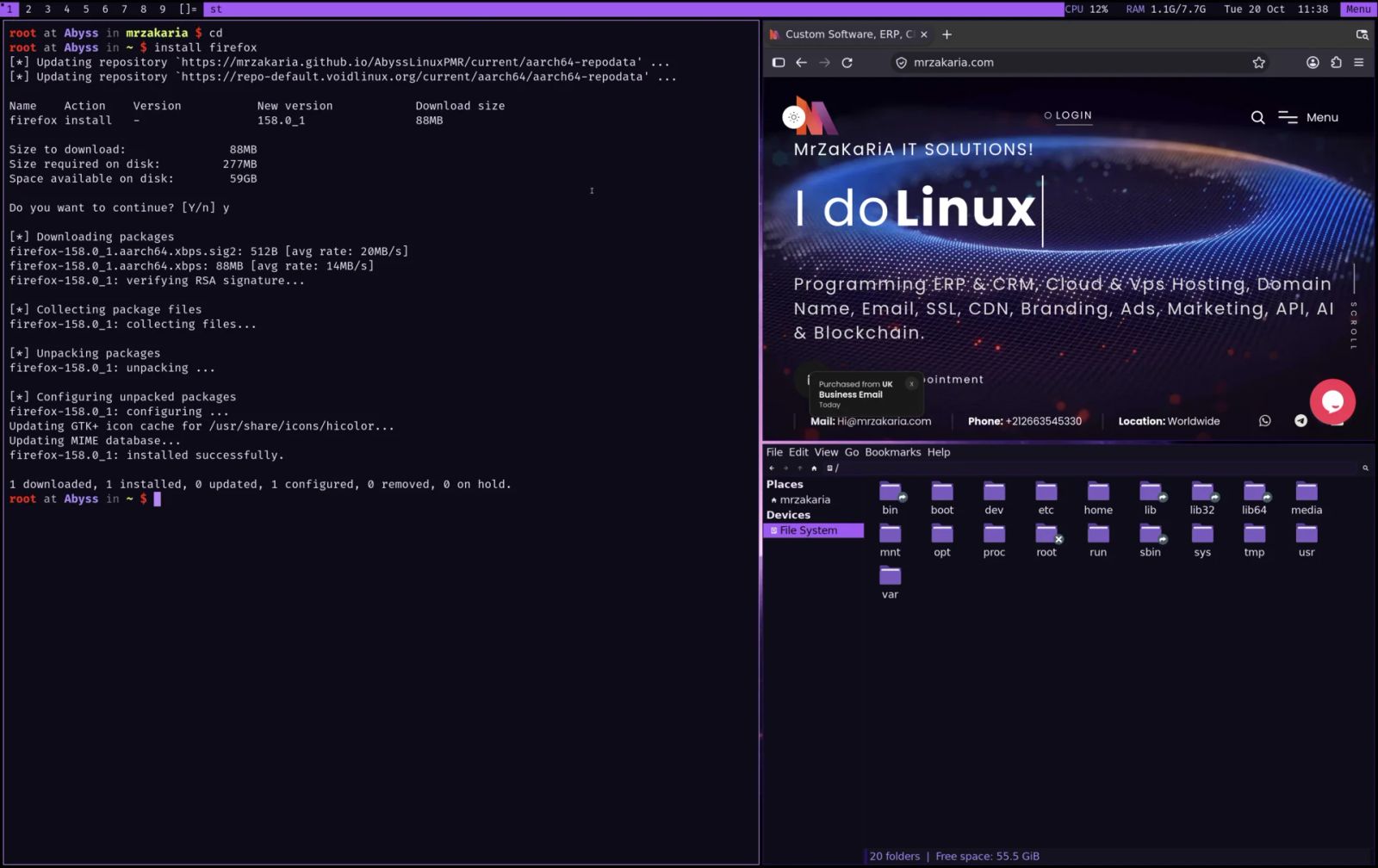
In my own screenshots, Abyss runs as an ARM64 guest on Apple Silicon. I install Firefox with xbps from a st terminal and browse mrzakaria.com in it, with dwm tiling the windows. The fetch panel reads CPU as Virtualized Apple Silicon with four cores, and about 360 MiB of 3.8 GiB of memory in use.
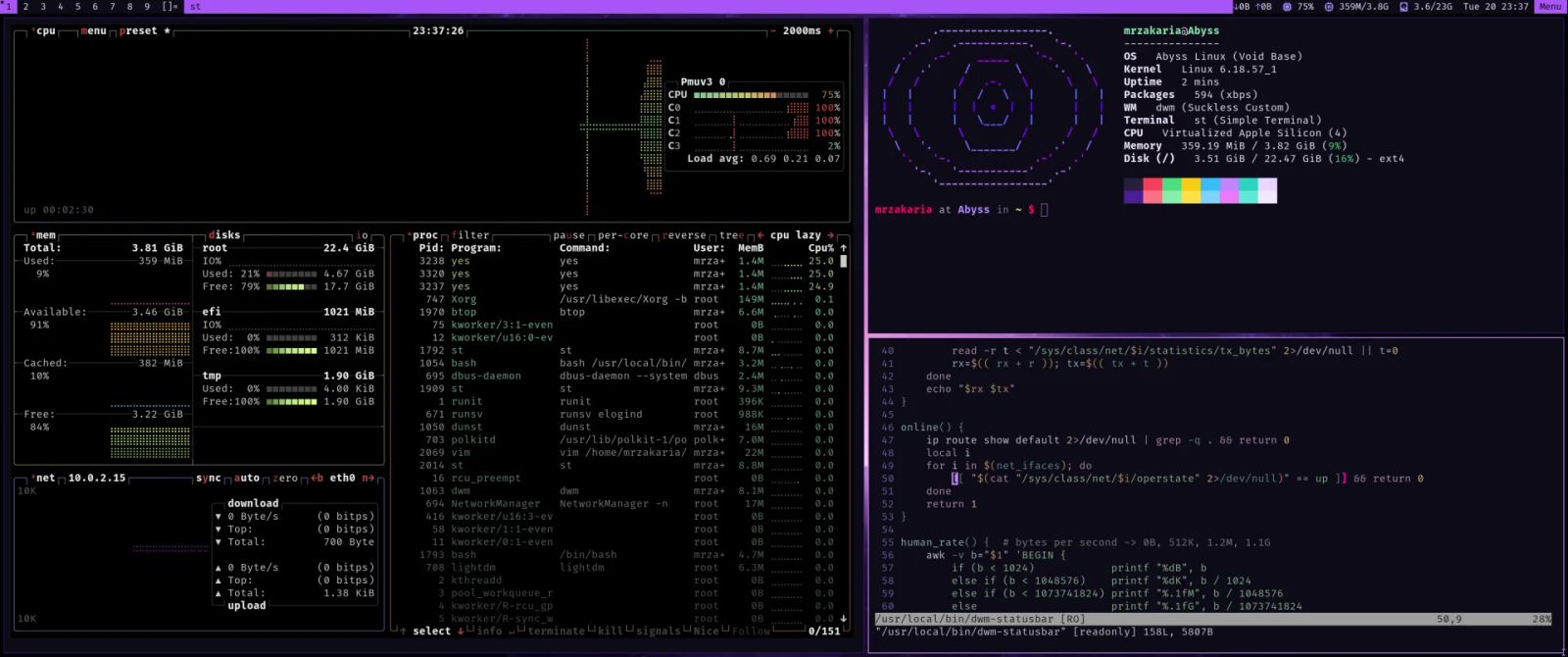
That is the whole point of the pair to me. One is the system I want to live in, the other is the way I carry it around on the machine I already own.
I do not want to depend on software I cannot read, so I wrote the software I want to read.
Why both are open source
Both projects are published under the MIT license. Abyss's scripts, overlay and docs are MIT, and Lumen's original code is too. Guest operating systems keep their own licenses, and Lumen asks you to bring your own installer.
I think that if the argument is that software should be readable, the only honest move is to let people read mine. Abyss is a community project, and it is not affiliated with Void Linux or suckless.org.
There are limits I should state. Lumen 27.1.0 is a source release that you build on your own Mac, and it is ad-hoc signed, not notarized. Abyss is days old.
What I take from it
Years of distro-hopping taught me what I wanted, and building the two projects was the cheapest way to get it. If you want a desktop you can read, or a VM app that respects your SSD, they are free to try.